WW2 damage

It’s not difficult to find damage from WW2 in Berlin.

Kaiser Wilhelm Memorial Church

Probably the most significant are the remains of Kaiser Wilhelm Memorial Church, consecrated in 1895 and all but destroyed during a night of air raids by Allied bombers in November 1943.

The photograph of the remains (below) were taken when we were in Berlin in 2008. Also below are photographs of the inside of the entrance hall below the ruin of the old spire.


Two from around the walls:


And two of the ceiling:


When we visited Berlin in 2008 I took my own photographs of the spire, but this time found the remains hidden inside shrouded scaffolding (below) while engineers assess the safety of the structure. The glass block buildings alongside is the new church consecrated in 1961.


The blue glass blocks (below) are the walls of the new place of worship from the inside.


The two photographs below all show buildings constructed post WW 2. Potsdamer Platz was virtually obliterated by Allied bombers, and then divided by the “Wall”. The photo Bahnhof Potsdamer Platz is one of the entrances to the underground railway station.


Museum Island

The final days of Berlin must have included fierce fighting around the buildings on Museum Island going by the still visible damage from small arms and larger calibre projectiles.

The external columns and walls of the Neues Museum exhibit numerous scars (below). Not hard to imagine soldiers sheltering behind the columns and inside windows and doors to return fire.


From the still-visible damage to the stonework around the base of bridges to the island over the Spree (below), the defenders probably viewed the river as a moat.


Siegessaule Victory Column

THE only monument to German military glory we saw in our travels around Berlin was the Siegessaule Victory Column, erected to celebrate Prussian military victories.

Being the aggressor in WW1 and WW2, and ultimately the loser, Germany must go a long way back to find something to highlight that can be considered acceptable.


Acceptable? Lonely Planet states that the column is now a symbol of Berlin's gay community and while the gilded lady on top represents the goddess of Victory locals irreverently call her Gold Else.

Those Nazi persecutors of Jews, gypsies and homosexuals, including Heydrich and Eichmann, must be "spinning in their graves".

Berlin beer


WE tasted numerous beers during our days in Germany, but none better than the Bavarian beer when we finally relaxed at the end of that first long day.

Reunifying Germany

Adjoining the Reichstag are two building, one each side of the River Spree that provide offices for parliamentarians and support staff and house other parliamentary support functions. In this part of Berlin the Spree was the divide between the former East and West, with the Reichstag in the West. The covered bridge over the Spree joining the two buildings is considered symbolic of the reunification of Germany.


Visible in the photo above are several crosses erected on the 'west bank' commemorating people who died fleeing the East. More crosses are erected near the Brandenburg Gate.

Historic and cultured city

WE spent four days exploring Berlin, after taking a city-wide tour in a hop-on/hop-off bus to decide what we wanted to look at in detail.

I’d never thought of Berlin as other than the city razed by the Allies towards the end of WW2, then divided by the infamous Wall for 28 years, and finally a potential major flashpoint during the Cold War, but I was surprised as we moved around the city.


Berlin records its history as going back before the 4th century AD, but its existing structural monuments, such as the well-known Brandenburg Tor (Gate) existed in the early 1800s.


Some historic buildings were destroyed by Allied bombers, necessitating reconstruction, and others badly damaged with repairs obvious.


The Brandenburg Gate (above) was opened to the public in 1791 and is iconic to Berlin and a major attraction for the many tourists who visit this city.

Repairs to damage caused by shrapnel and other projectiles are apparent from the different coloured stone used for patching and replacement of severely damaged sections of the structure.


The first photo,showing the traffic lights is from the West,
and the monochrome photo from a 1961 postcard shows The Wall sealing the Gate inside the East.

The Wall completely enclosed the Brandenburg Gate within the East, and the curved footpath on the other side of the road aligns with the location of The Wall.


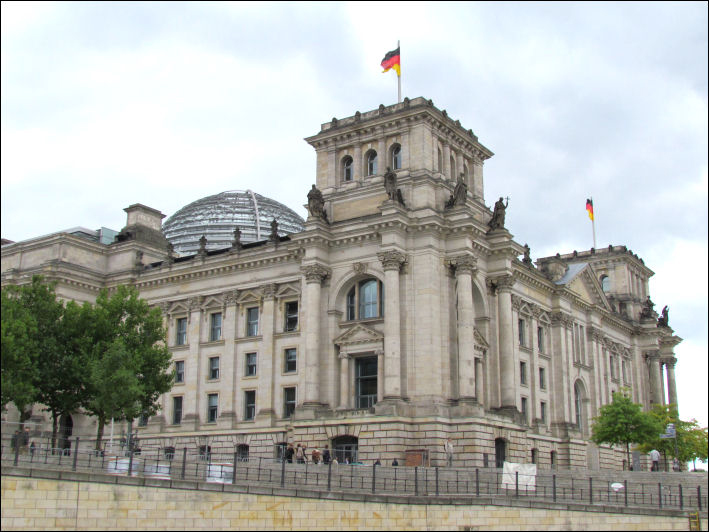
The Reichstag (below) - home of the Bundestag, the German parliament - is an imposing building with its glass dome.


Extensively damaged in WW2, some may have seen the picture of victorious Red Army soldiers hoisting their flag on the building in 1945, and the glass dome is post 1945.  

The second and third photos were taken from a cruise on the Spree River.

Museum Island, bounded by the Spree River and Landwehrkanal, houses several museums and the National Gallery.

Pergamonmuseum

Significant is the Pergamonmuseum with its collection of Greek and Roman classical antiquities and museums of the ancient near east and Islamic art.

Below, the reconstructed Market Gate of Miletus from the early 2nd century AD. The close-up photo is part of the Market Gate to show the intricate stonework; some restoration was necessary after WW2 when bombing damaged the roof allowing rain to reach the stonework.


Below, the Ishtar Gate from 6th century BC Babylon.


Below, the Pergamon Altar circa 170 BC


Also on Museum Island is the National Gallery (below) with an imposing Friedrich Wilhelm one-time King of Prussia on horseback at the front.


Altes Museum (above) houses Roman and Greek art and sculpture.

The Berlin Protestant Cathedral (below), the former royal court church, has a crypt with numerous bronze and marble sarcophagi the final resting place of the Prussian royal family and other notables.


Note the detail in the bronze doors.

Checking Point Charlie

Monday, September 5, 2011

MONDAY saw me out of bed early to buy bread as w
e’d found a toaster in the kitchen of our hotel suite.

Took the long way to the shop to see what was ar
ound the next corner and found myself at Check Point Charlie.

Check Point Charlie (CPC) was the name given to the border crossing in the American Sector of the former West Berlin.

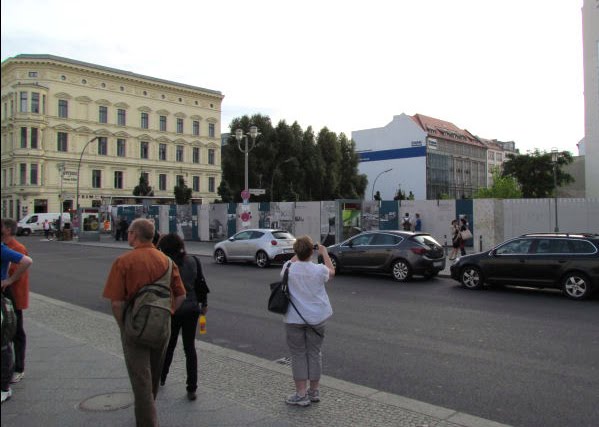
In 2008 we visited CPC, but only from the former Western side, and this time, approaching from the East, I was intrigued to see the change that had since occurred in development on the site of the infamous Wall.


A multi-storey building was being erected on the former site of The Wall that had previously been land cleared on the Eastern side of The Wall to accommodate a minefield and other barriers to prevent East Berliners escaping to the West.

There is extensive building and infrastructure works underway in the former East to move it on from the stultified, and concerning its citizens trying to flee to a better life in the West, murderous approach of the former socialist dictatorship.


These photographs show CPC approached from the West, with a large photo of an East German border guard heralding entry to the East and, beyond the crossroad behind him was The Wall while, in the other direction, a photo of a US serviceman with the West behind him.

Even today, so long after The Wall was torn down in 1989, the starkness of the East is obvious when compared to the West.


The photographs (above) show Sandra standing at the site of The Wall where it crossed Friedrichstrasse south of CPC and the hoardings with commemorative posters erected at "no man’s land".

In these photographs (above) the West and CPC are to the left of the first image, and a remnant of The Wall opposite the still-standing Nazi-era German Air Ministry in Wilhelmstrasse with a fence that has failed to deter souvenir-hunters.


The photos above are of dull, uninspired blocks of flats erected in the East before the fall of The Wall and subsequent reunification of Berlin.

Few balconies and the only garden a window box and o
ur apartment hotel, the Adina, is the darker building on the left of this photo looking west along Krausenstrasse.


An oasis in this socialist-inspired unimaginative housing ghetto is the renovated Adina Hotel, the final photo, and The Adina has a strong connection with Australia, being part of the Medina Group.

Apparently use of the name Medina in Germany is not appropriate.
Surprised to see Aboriginal art in the passageways and large photos of recognisable Australian landscapes on the walls of the reception and waiting lounge.

And, a large map of Australia pinpointing numerous of our vignerons, including "Craiglee" by Pat Carmody at Sunbury, in the restaurant/bar.